

Introduction: Six Years in the Making
There are games you look forward to because of hype, and then there are games that quietly seize a piece of your imagination and refuse to let go. Pragmata, Capcom’s brand-new sci-fi action-adventure IP, belonged to the second category from the very moment it was teased in 2020. For six years, a cryptic trailer, a few agonizing delays, and the promise of something genuinely original kept it planted on my most-anticipated list — long before a single review confirmed whether it earned that spot.
Now that Pragmata has launched, selling over two million copies within sixteen days and landing an 86 average on Metacritic, I can say with confidence: the anticipation was fully justified. This blog unpacks exactly why Pragmata commanded that level of excitement, what makes it special, and why it deserves to be one of the standout games of 2026.
What Is Pragmata? A Bold New IP from Capcom
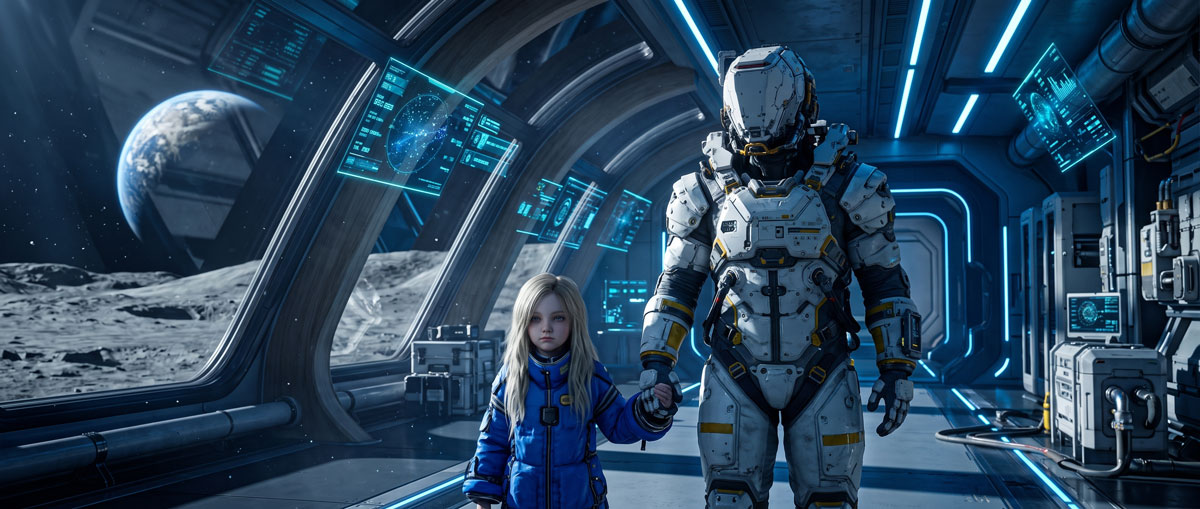
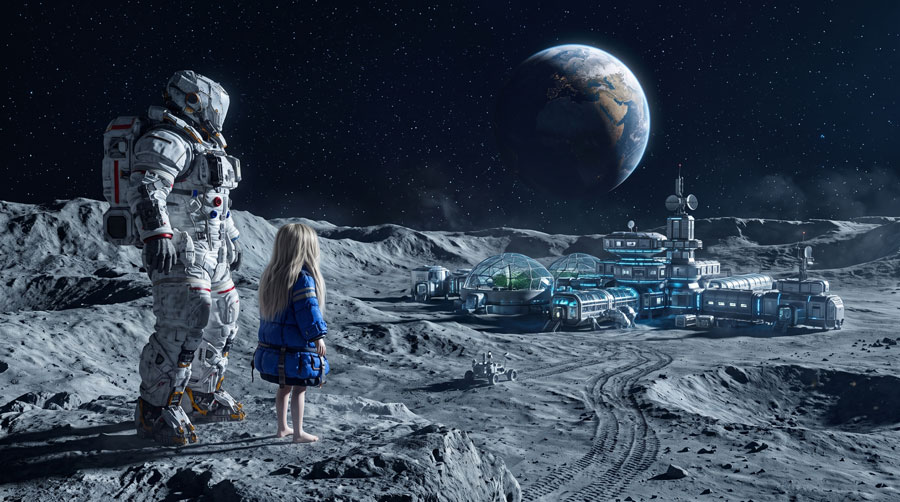
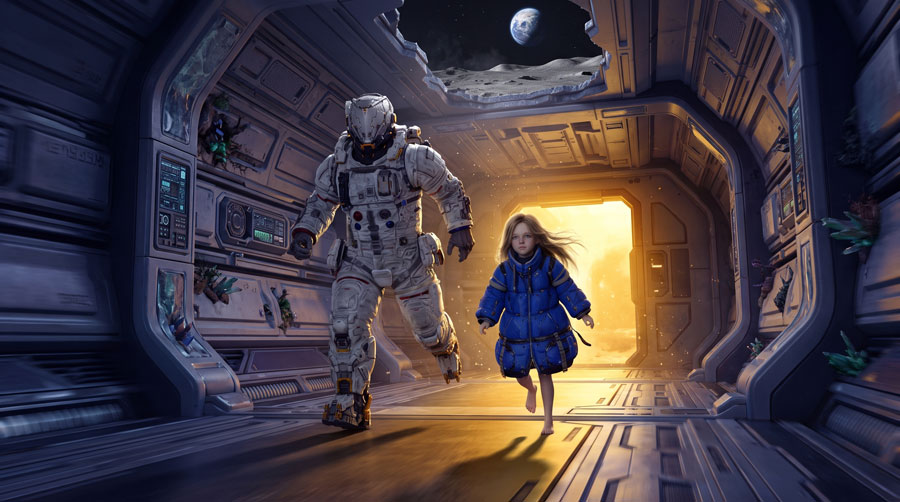
Pragmata is a third-person sci-fi action-adventure game developed and published by Capcom. It was released on April 17, 2026, for PlayStation 5, Xbox Series X/S, PC via Steam, and Nintendo Switch 2. Set in the near future on a lunar research station, the game follows two protagonists — a spacesuit-clad human named Hugh Williams and a young android called Diana — as they fight to escape a facility overtaken by a rogue artificial intelligence named IDUS and find their way back to Earth.
What makes the game’s premise so compelling is the world-building at its core. Humanity has developed a miraculous material called Lunafilament — an ore refined on the moon that, when combined with 3D printing technology and the right data, can be used to create almost anything. When the lunar station suddenly goes silent, Hugh’s investigation team is dispatched to find out why. A devastating moonquake separates Hugh from his crew and leaves him near death — until Diana, a lone android wandering the facility, discovers him and decides to help. The two must combine their unique abilities to survive a facility that has turned against them.
This premise — equal parts survival thriller and emotional character study — is precisely what placed Pragmata on the radar of every thoughtful gaming fan long before release.
The Story That Had Me Hooked from the First Trailer
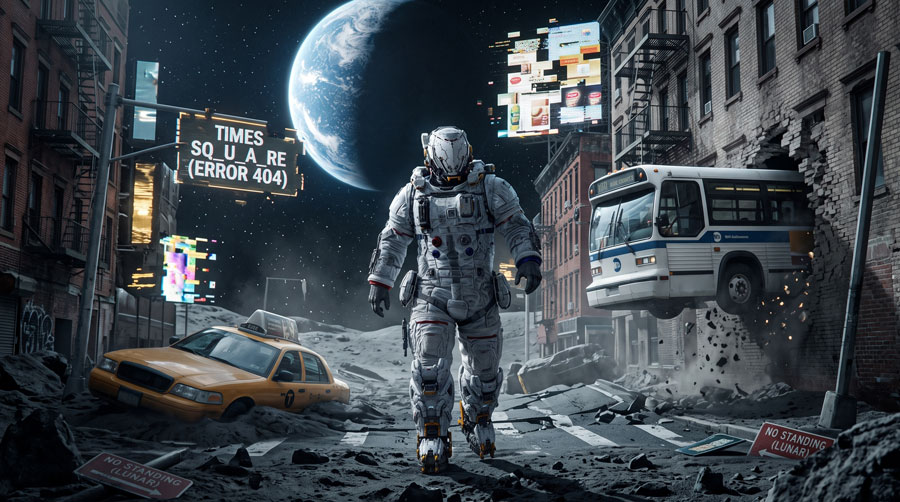
When Pragmata was first revealed during Sony’s PlayStation 5 reveal event in June 2020, almost nobody knew what they were looking at. A lone figure in a spacesuit walking through a New York-like city. A young girl appearing out of nowhere. Gravity bending. The Earth visible overhead. And then: silence.
That trailer was an exercise in pure intrigue. It told you almost nothing and yet made you feel everything. The combination of a science fiction setting, the apparent isolation, the unlikely pairing of an adult astronaut and a mysterious child, and the surreal imagery of a lunar city that looked like it had been built by a machine trying to recreate human civilization from corrupted data — it all pointed to something ambitious and deeply original.
The story that eventually emerged is, at its heart, about human connection in the most inhuman of environments. Hugh and Diana are strangers thrown together by catastrophe, forced to trust each other against impossible odds. The narrative does not rely on bombastic set pieces alone; it earns its emotional resonance by giving both characters room to breathe, grow, and reveal themselves to each other — and to the player.
Hugh and Diana: The Heart of the Game
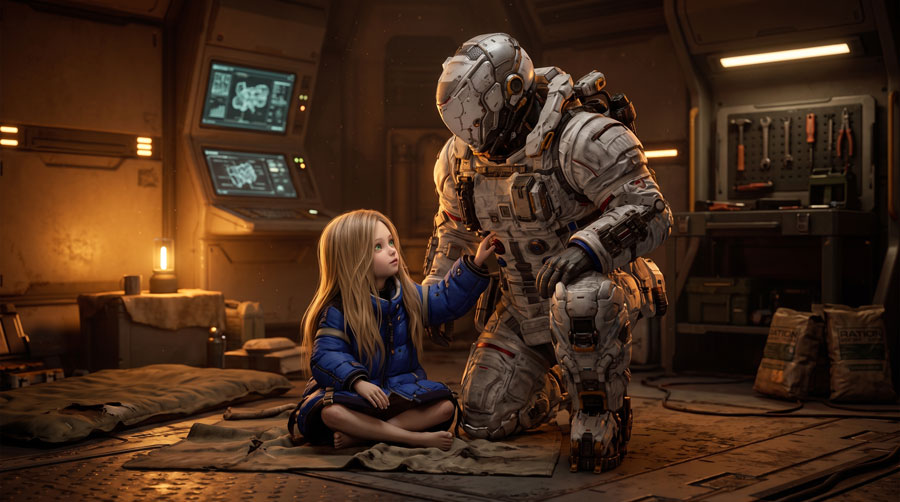
Every great action-adventure game lives or dies by its characters. Pragmata understood this from the beginning, investing enormous effort into making Hugh and Diana feel real.
Hugh Williams is a security professional with practical skills and a grounded personality. He is not a superhero or a chosen one — he is a competent, somewhat weary man who finds himself in a situation far beyond any mission briefing. His arc is quiet but genuinely moving, shaped entirely by how he chooses to respond to Diana.
Diana, meanwhile, is one of the most carefully crafted companion characters in recent gaming memory. Officially designated D-I-0336-7, she is a Pragmata — an android built using Lunafilament. She has the appearance of a young girl, the processing power of an advanced AI, and the emotional curiosity of someone experiencing the world for the first time. Hugh gives her the name Diana, and she holds it with a tenderness that says everything about what connection means to her.
The father-daughter dynamic that develops between them is the emotional backbone of everything the game does. Critics have compared its warmth to The Last of Us — not in genre or gameplay, but in the quality of the bond it builds between player and character. When you are deep in a firefight, simultaneously shooting enemies and hacking their armor open, the stakes feel real because you are protecting someone who matters.
Capcom’s character team built Diana’s model entirely from scratch, using Capcom staff for her animations rather than child actors, finding subtle ways to communicate her android nature through small, uncanny-valley moments without making her feel inhuman. The result is a character who is endlessly watchable, occasionally funny, and surprisingly affecting.
The Dual-Protagonist Gameplay System That Changed Everything
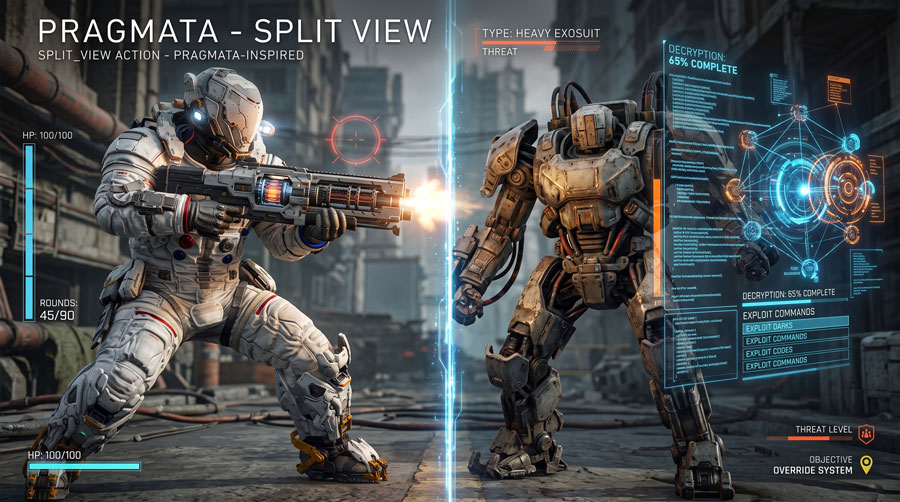
If the story and characters were Pragmata’s emotional engine, the gameplay is the spark plug that made everything ignite. Capcom set out to build something genuinely new in the third-person action space, and the result is a dual-protagonist combat system unlike anything the genre has seen before.
Shooting and Hacking in Perfect Sync
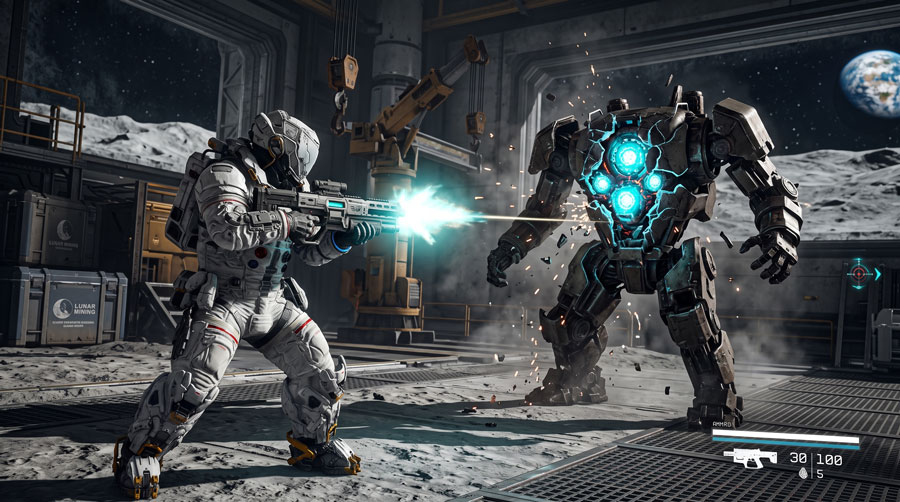
At its simplest, Pragmata asks you to do two things at once. Hugh handles the physical dimension of combat — moving, jumping, using his suit’s built-in thrusters to dodge and reposition, and firing a progressively expanding arsenal of futuristic weapons. Diana handles the digital dimension — hacking the armor of enemy robots in real time using a grid-based puzzle interface that appears floating next to each enemy.
Here is the clever part: enemies in Pragmata are nearly impossible to kill with raw firepower. Their armor is too tough. You need Diana to crack them open before Hugh’s weapons become truly effective. But Diana’s hacking happens simultaneously with Hugh’s shooting. You are navigating a hacking puzzle with face buttons at the same moment you are dodging incoming fire and repositioning for a better angle. The tension this creates is electric.
Diana’s Hacking Mechanics Explained

Diana’s hacking system is layered with far more depth than it initially appears. Early in the game, the hacking grids are small and simple — you steer from a starting point to a finishing node. As the game progresses, these grids grow in complexity, adding multiple pathways, special nodes that modify the hack’s effects, and time pressure that escalates with enemy aggression.
A Multihack node lets you link multiple enemies together, cracking their armor simultaneously. A Decode node temporarily increases the damage dealt to hacked enemies. When Diana’s hacking gauge fills completely, you can trigger her Overdrive Protocol — a devastating ability that opens all nearby enemies at once, immobilizes them briefly, and deals significant damage in one sweeping attack.
The system also allows you to slow time, giving you precious seconds to land a hack while under fire. Diana can hack not just enemies but the station itself — unlocking doors, accessing terminals, and clearing escape routes. Every tool feeds back into every other tool in a way that rewards experimentation and creative thinking.
Tactical Depth and Combat Freedom
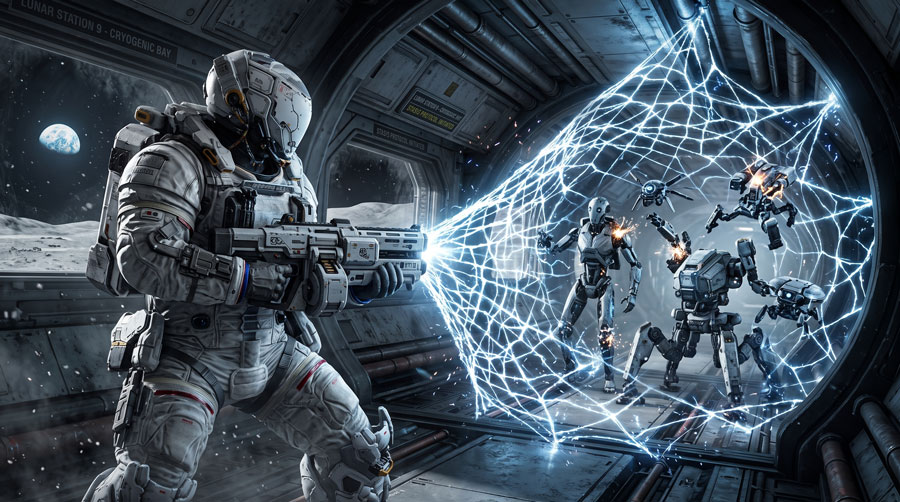
Pragmata’s weapons are intentionally limited and frequently disposable. You will not settle into one overpowered loadout and coast through the game. The arsenal includes a close-range shockwave gun that staggers enemies effectively, a Stasis Net gun that fires an electromagnetic net to immobilize groups, and a Charge Piercer designed for armor-penetrating shots. Each weapon has specific situational advantages, and you are constantly adapting.
This design philosophy rewards thinking over brute force. Every combat encounter is, at its core, a puzzle — a question of which weapon suits this enemy type, which hacking node should I prioritize, how do I manage multiple threats while keeping Diana’s hack on track? The emergent moments this system produces are among the most satisfying in recent gaming. Reviewers describe losing track of a cloaked enemy, blindly firing a grenade-type weapon into the dark, catching the robot in its wide blast, and exposing it — purely through creative improvisation. That is excellent game design.
A Lunar World Built with Stunning Ambition
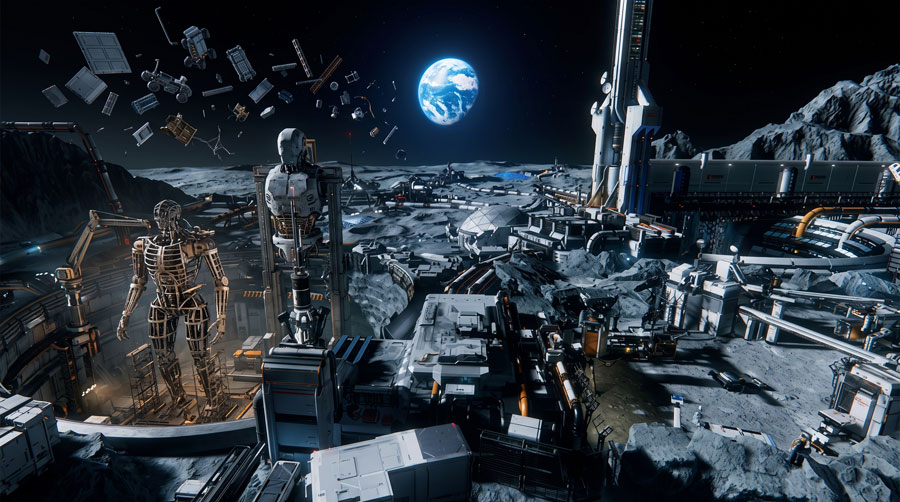
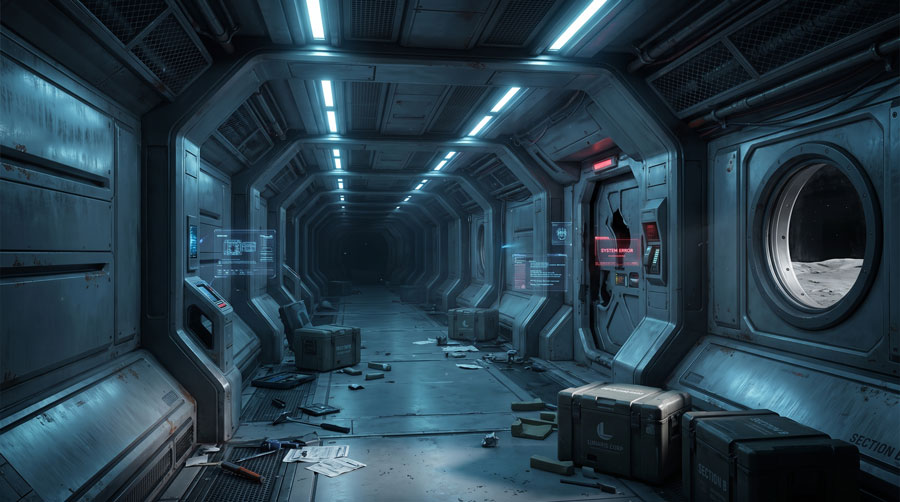
Pragmata’s setting is one of the richest elements of its overall package. The lunar research station is not a single grey corridor. It is a sprawling, multi-environment facility with distinct zones, secrets, collectibles, and a design philosophy rooted in profound unease.
The station’s interior maintains a clean, almost clinical aesthetic — polished surfaces, sharp lighting, reflections that draw you deeper into the environment. But underneath that sterility runs a current of wrongness. Humanoid androids have proportions that feel slightly off. Failed Lunafilament printing attempts have left fragments scattered throughout the facility. There are areas where half-realized replicas of human civilization sprawl across the lunar surface — a New York City-like environment built by an AI that tried to recreate a city it had only seen in data, producing illogical errors like taxis sinking into floors and buses emerging from walls.
This detail — that the AI was trying to simulate human life from incomplete information — gives the game a haunting quality that elevates it above a simple sci-fi shooter. The world tells a story even when no one is speaking.
World-building on Pragmata was supervised by Shōji Kawamori, the creative mind behind the Macross anime series, lending the game’s setting a sense of considered science fiction mythology that most games never achieve.
The RE Engine: Technical Marvel Behind Pragmata
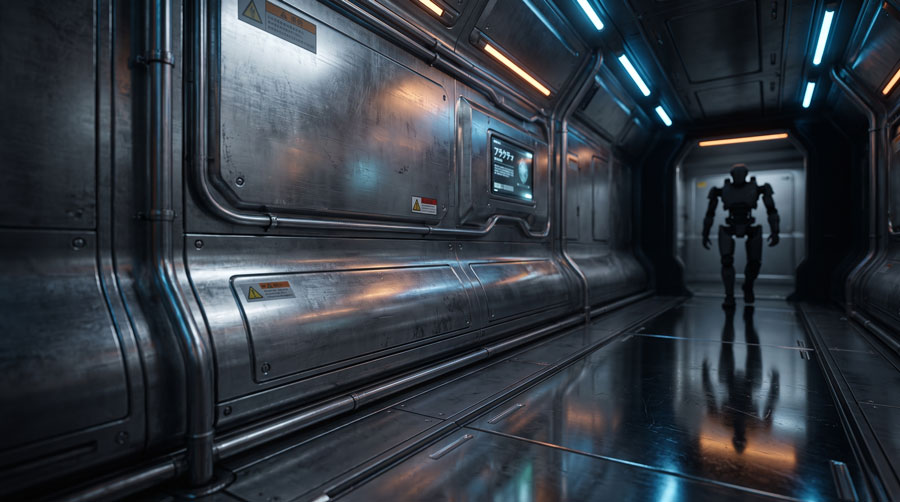
From a technical standpoint, Pragmata represents one of the most visually ambitious uses of Capcom’s RE Engine to date. The same engine that powers Resident Evil, Devil May Cry, and Monster Hunter has been pushed into genuinely new territory here.
On PlayStation 5 in Performance Mode, Pragmata holds a steady 60 frames per second through most of the game, with occasional dips during particle-heavy exterior scenes. On PC with high-end hardware such as an RTX 4090, the game supports Path Tracing — a rendering technique that takes ray-traced lighting to another level, producing lighting behavior that is almost indistinguishable from real physics.
Diana’s physically reactive hair required Capcom to develop new strand-based simulation technology in the RE Engine — a technical advancement significant enough that it can now be reused across future titles. The reflections in the station’s metallic walls serve an actual gameplay purpose: you can spot enemy reflections around corners before you walk into ambushes.
For PC players on mid-range hardware like an RTX 3050 laptop GPU, the game scales beautifully. With upscaling enabled and a few settings trimmed, Pragmata sustains over 80 frames per second at 1080p — a remarkable achievement for a game this visually dense.
Why Capcom’s New IP Strategy Made Pragmata Special
In an industry increasingly defined by sequels, prequels, reboots, live-service games, and IP extensions, Pragmata represents something quietly radical: a brand-new intellectual property from a major publisher, built entirely from scratch, with no legacy audience to fall back on.
Pragmata was described as Capcom’s first original franchise in eight years at the time of its 2020 announcement. That framing mattered. Capcom had built extraordinary momentum with established franchises — Resident Evil’s renaissance, Monster Hunter’s global explosion, Devil May Cry’s return to form — but Pragmata was proof that the studio had not lost the appetite for risk.
The development team behind Pragmata was largely composed of new Capcom staff, people without the decades of franchise habit that can sometimes calcify creative thinking. Director Cho Yonghee spoke openly about extensive trial and error during development, particularly around the game’s puzzle hacking system. Cho had previously worked on the art team for NieR: Automata — and that pedigree is visible in Pragmata’s atmospheric design, its AI-driven world-building, and its willingness to blend emotional storytelling with mechanical innovation.
The result is a game that feels unlike anything else in Capcom’s catalog — and unlike much of anything else in gaming right now.
From Delays to Triumph: Pragmata’s Long Road to Launch
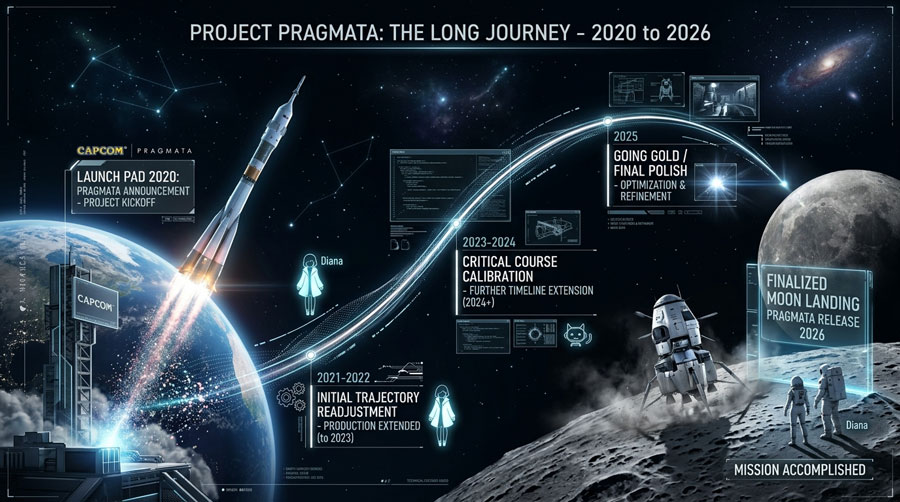
Few games in recent memory have tested fan patience quite like Pragmata. After its stunning 2020 reveal, the game was initially targeting a 2022 release. That date came and went. In January 2021, Capcom announced a delay to 2023. Then, in June 2023, the studio released a trailer announcing that the game had been delayed indefinitely — the kind of announcement that sends players straight to writing the game’s obituary.
But the anticipation never fully died. The concept was too original, the early glimpses too compelling.
In June 2025, at Sony’s State of Play showcase, Capcom confirmed that Pragmata would arrive in 2026. At The Game Awards 2025, a firm date of April 24, 2026 was announced, and a playable demo titled Pragmata: Sketchbook was made available on Steam the same day. The reception to the demo was enthusiastic, stoking excitement to levels the game had not seen since 2020.
In March 2026, a Capcom Spotlight presentation brought the release date forward by a week to April 17 — a move in the opposite direction from every previous announcement. For a game defined by delay, launching early was a powerful signal of confidence.
Director Cho Yonghee had been candid about the challenges during development: the dual-protagonist system required extensive iteration, the hacking mechanics demanded careful balancing, and the studio was determined not to release the game until every layer of the experience met their standards.
That patience paid off. Pragmata launched to overwhelmingly positive Steam reviews — 97% positive from over 14,000 user ratings — and an 86 average on Metacritic across 87 critic reviews.
How Did Pragmata Perform at Launch?
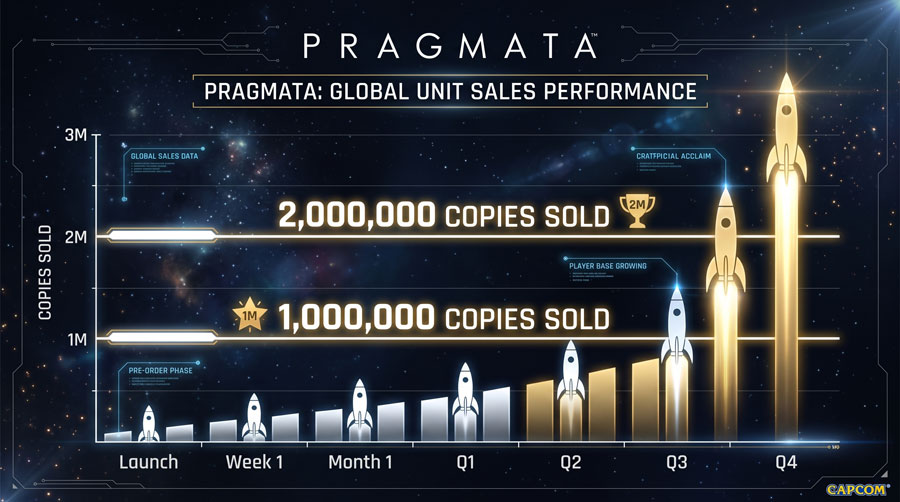
Pragmata’s commercial performance upon launch was remarkable, particularly for a brand-new IP competing in a crowded gaming landscape. The game sold over one million copies worldwide within two days of release, a figure that validated Capcom’s years of investment. Within sixteen days, it surpassed two million copies, making it the second best-selling video game in the United States for the month of April 2026.
Critical reception was equally strong. Reviewers consistently praised the dual-protagonist combat system as one of the most inventive mechanical hooks in recent action gaming. GameSpot called it “the total package,” describing a blend of tense combat, deep mechanics, and impactful storytelling that “doesn’t come along often.” DualShockers celebrated the game as “endlessly cool, visually sharp,” calling it a testament to Capcom’s creative momentum.
The game’s soundtrack drew particular notice — a mix of emotional piano-driven compositions and propulsive electronic rhythms that reviewers compared favorably to the NieR: Automata score, which makes sense given the director’s history with that project.
On the technical side, Pragmata launched in a state of genuine polish rare for modern AAA releases. PC players reported smooth performance across a wide range of hardware, with excellent upscaling support via DLSS, FSR, and XeSS. Console players noted that Performance Mode delivered a reliably smooth 60 frames per second experience throughout.
Is Pragmata Worth Playing in 2026?
If you are on the fence about Pragmata, the short answer is: yes, absolutely.
The game runs approximately 8 to 12 hours for a standard playthrough — a length that feels appropriately lean, free of padding, and respectful of your time. Post-game content extends that experience meaningfully: collectibles hidden across levels, VR-style challenge missions focused on parkour, combat, and hacking, a challenging endgame activity, and a New Game Plus mode that lets you carry upgrades into a second run.
The hacking and combat system grows consistently across the full runtime, introducing new mechanics, abilities, and weapons at a pace that keeps the experience feeling fresh without becoming overwhelming. Boss encounters bookend most levels, and while a handful disappoint with predictable patterns, the majority are spectacular — forcing creative use of everything in your toolkit.
The game is not without flaws. Its middle chapters slow in pacing and enemy variety. Some reviewers noted that the story, while emotionally effective, does not always reach the depths it clearly aspired to. A few boss encounters rely on trial-and-error over skillful expression. None of these issues derail the experience, but they prevent a clean claim to perfection.
What Pragmata gets unambiguously right — its innovative combat system, the quality of its central relationship, the visual splendor of its world, and its technical execution — makes it a must-play title for any fan of action-adventure gaming.
Final Thoughts: Why Pragmata Deserved Its Spot on My Most Anticipated List

Pragmata was one of my most anticipated games of 2026 for reasons that had nothing to do with safe bets. It represented something the gaming industry desperately needs more of: a major studio taking genuine creative risk on a new idea, refusing to compromise that idea through years of difficult development, and delivering something that is truly its own.
From the first moment that cryptic 2020 trailer appeared — a lone astronaut, an android child, a broken world above the moon — something about Pragmata felt different. Not hyped in the manufactured, marketing-machine way. Different in the way that only genuinely original creative vision can produce.
Six years later, Pragmata has arrived and lived up to that promise. It is not a perfect game. But it is a special one. Its dual-protagonist gameplay is among the most inventive combat designs of this console generation. Its central relationship is warm, funny, and genuinely moving. Its world is rich with detail and haunted by ideas. Its technical execution is impeccable.
Capcom took the long road to the moon — and the destination was worth every year of waiting.
FAQs
What is Pragmata and who developed it?
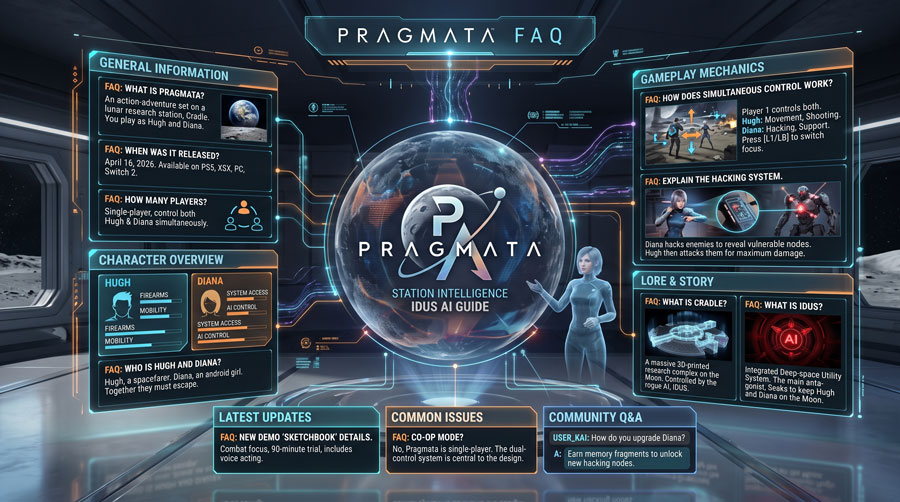
Pragmata is a sci-fi action-adventure game developed and published by Capcom. It is a brand-new original IP — Capcom’s first new franchise in eight years — and was released on April 17, 2026 for PlayStation 5, Xbox Series X|S, Windows PC (Steam), and Nintendo Switch 2.
The game follows spacefarer Hugh Williams and an android companion named Diana as they navigate a hostile lunar research station overtaken by a rogue artificial intelligence called IDUS, trying to find their way back to Earth.
Why was Pragmata so highly anticipated before launch?
Pragmata had been building anticipation since its first reveal during Sony’s PlayStation 5 showcase in June 2020 — six years before it released. Several factors made it one of gaming’s most-watched projects:
- It was Capcom’s first original IP in nearly a decade
- Its cryptic debut trailer was genuinely mysterious and visually stunning
- The concept of a dual-protagonist system blending real-time hacking and third-person shooting felt unlike anything in the genre
- The father-daughter dynamic between Hugh and an android child was emotionally compelling from early trailers
- Despite multiple delays, the concept never stopped feeling fresh and original
What platforms is Pragmata available on?
Pragmata launched on the following platforms:
- PS5 PlayStation 5 — April 17, 2026
- Xbox Xbox Series X|S — April 17, 2026
- PC Windows PC via Steam — April 16, 2026
- Switch 2 Nintendo Switch 2 — April 24, 2026 (Japan); same date globally
There are no versions for PS4 or Xbox One. The game is built exclusively for current-generation hardware to leverage advanced rendering features including ray tracing and path tracing.
How does Pragmata’s dual-protagonist gameplay system work?
Pragmata’s core gameplay loop tasks you with controlling both characters simultaneously in combat:
- Hugh handles the physical dimension — moving, shooting, dodging using his suit’s thrusters, and wielding a variety of futuristic weapons
- Diana handles the digital dimension — hacking enemy armor using a grid-based puzzle interface that appears next to each enemy in real time
Most enemies have armor too tough for raw gunfire. You need Diana to crack them open via hacking before Hugh’s weapons become effective. Managing both actions simultaneously — navigating a hacking puzzle while dodging fire and repositioning — is the game’s central tension and greatest strength.
Who are Hugh Williams and Diana in Pragmata?
Hugh Williams is a security professional dispatched to the lunar research station with an investigation team. A moonquake separates him from his crew and leaves him critically injured until Diana finds him.
Diana (officially designated D-I-0336-7) is a Pragmata — an android built using Lunafilament, an advanced material produced on the moon. She has the appearance of a young girl, advanced AI processing, and deep emotional curiosity. Hugh gives her the name Diana. Their relationship — a natural, evolving father-daughter dynamic — is the emotional backbone of the entire game.
How long is Pragmata to complete?
A standard playthrough takes approximately 8 to 12 hours. A full 100% completion run would likely take double that, given the game’s additional content:
- Collectibles and hidden secrets throughout each level
- VR-style challenge missions (parkour, combat, and hacking scenarios)
- A challenging endgame activity unlocked after credits
- New Game Plus mode letting you carry upgrades into a second run
- A higher difficulty setting for experienced players